

Why Professional Development Fails—and how to optimize it with learning science
We invest billions in teacher development - while ignoring how humans learn. Educators are the solution, yet our systems often frustrate and alienate them.


For decades, education systems have invested heavily in professional development for teachers. The assumption is simple: if we want better student outcomes, we need better teaching and if we want better teaching, we need to train teachers.
And yet, despite this sustained investment, the impact of professional development on classroom practice and student learning has remained uneven at best.
The reason is not a lack of effort. It is a compounding paradox.
We ask teachers to improve learning outcomes through professional development that is often disconnected from how humans actually learn.
At the same time, we rarely provide teachers with a coherent, research-based understanding of how learning works; how memory, prior knowledge, practice, and feedback shape what students retain and can use. As a result, teaching itself remains partially decoupled from learning. Educators are expected to produce better results without being systematically equipped with the science that governs those results (National Academies of Sciences, Engineering, and Medicine, 2018; OECD, 2023).
This disconnect is compounded by a second paradox: the way we design professional development often contradicts the very principles it should embody.
We know, for example, that learning requires active engagement, practice over time, feedback, and application in context. Yet much of professional development remains episodic, passive, and detached from the daily work of teaching (Desimone, 2011; Darling-Hammond et al., 2017). Teachers attend workshops, consume content, and return to classrooms with limited support for implementation. Exposure is mistaken for learning; attendance is mistaken for change.
A third paradox may be the most consequential: in trying to improve teaching, we often overwhelm teachers.
Educators today are frequently asked to adopt new curricula, new frameworks, and new initiatives—often simultaneously and with limited coherence. This accumulation of demands contributes to stress, burnout, and diminishing returns. When teachers are already struggling with high levels of stress, what they need is not another initiative, but support that helps them become more effective in what they are already doing (Diliberti, Schwartz, & Grant, 2021).
Taken together, these dynamics help explain why professional development so often underdelivers. It is not that we lack knowledge about how to improve teaching. It is that our systems are not aligned with that knowledge.
A more effective approach begins by resolving these paradoxes.
First, professional development must be grounded in the science of learning, providing educators with a clear and usable understanding of how students learn. Without this foundation, efforts to improve instruction remain fragmented and inconsistent.
Second, professional learning itself must reflect those same principles. It must be sustained over time, actively engage teachers in practice, and be embedded in their daily work. Learning cannot be reduced to events; it must be designed as a process.
Third, improvement must be approached not as adoption, but as refinement. Drawing on improvement science and implementation research, effective systems balance fidelity to evidence-based practices with adaptation to local contexts, supported by ongoing feedback and iteration (Bryk et al., 2015; Fixsen et al., 2020). The goal is not to layer new initiatives onto teachers’ work, but to strengthen the quality of what is already happening in classrooms.
When these elements come together, professional development shifts in kind. It moves from episodic to continuous, from theoretical to applied, and from burdensome to enabling.
The question is no longer whether we can improve teaching. The research base is clear that we can. The question is whether we are willing to redesign professional learning systems so that they align with how humans learn, with how teachers work, and with what schools actually need.
Why Both Dominant Models of Professional Development Fall Short—and What Works Instead
When teachers are experiencing high levels of stress and burnout, professional development must reduce—not add to—their cognitive and instructional burden. Evidence suggests that educators benefit most from support that strengthens the effectiveness of their existing practice, rather than requiring the adoption of new curricula or disconnected initiatives.
(Diliberti, Schwartz, & Grant, 2021; OECD, 2023)
One way I have tried to translate these principles into practice is through work developed with COGx, where these learning-science principles are built into the structure of professional development rather than added as afterthoughts.
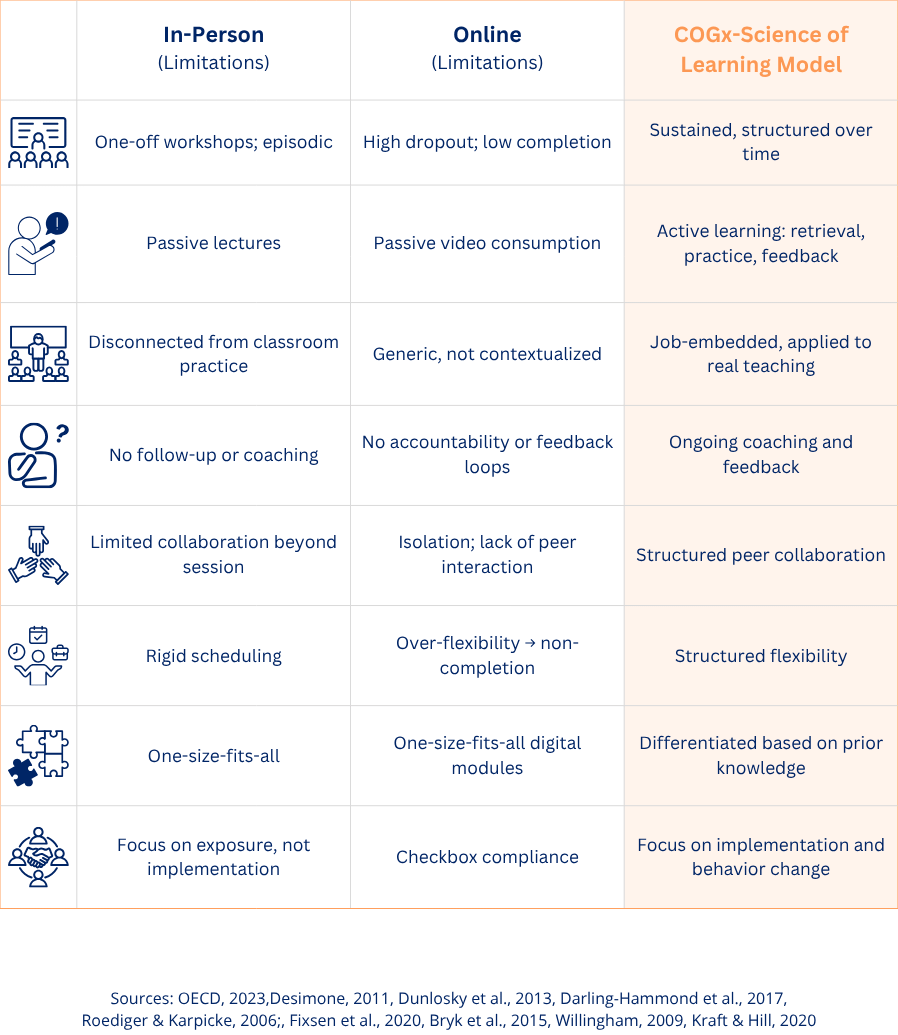
COGx contextualizes its programs to each partner’s unique needs through a process of adaptive integration—preserving the core elements of proven, research-based models while enabling thoughtful customization to local contexts. This approach reflects a growing body of research in continuous improvement and implementation science demonstrating that impact depends on balancing fidelity to core design with responsiveness to context, supported by ongoing coaching, feedback, and iterative refinement.
(Bryk et al., 2015; LeMahieu, 2011; Fixsen et al., 2020; Metz & Bartley, 2021; OECD, 2023; William T. Grant Foundation, 2024)
What has been your experience with PD? Share your thoughts in the comments below.
References
Bryk, A. S., Gomez, L. M., Grunow, A., & LeMahieu, P. G. (2015). Learning to improve: How America’s schools can get better at getting better. Harvard Education Press.
Darling-Hammond, L., Hyler, M. E., & Gardner, M. (2017). Effective teacher professional development. Learning Policy Institute.
Desimone, L. M. (2011). A primer on effective professional development. Phi Delta Kappan, 92(6), 68–71.
Diliberti, M., Schwartz, H. L., & Grant, D. (2021). Stress topped the reasons why public school teachers quit, even before COVID-19. RAND Corporation.
Dunlosky, J., Rawson, K. A., Marsh, E. J., Nathan, M. J., & Willingham, D. T. (2013). Improving students’ learning with effective learning techniques. Psychological Science in the Public Interest, 14(1), 4–58.
Fixsen, D. L., Naoom, S. F., Blase, K. A., Friedman, R. M., & Wallace, F. (2020). Implementation research: A synthesis of the literature.
Kraft, M. A., & Hill, H. C. (2020). Developing ambitious mathematics instruction through coaching. American Educational Research Journal, 57(6), 2584–2621.
National Academies of Sciences, Engineering, and Medicine. (2018). How people learn II: Learners, contexts, and cultures. National Academies Press.
OECD. (2023). Unlocking high-quality teaching.
Roediger, H. L., & Karpicke, J. D. (2006). Test-enhanced learning. Psychological Science, 17(3), 249–255.
Willingham, D. T. (2009). Why don’t students like school?
This crisis we're witnessing, so well described in this article, seems endless despite the countless analyses being done. I hope we'll one day escape this limbo: more learning and fewer meaningless measurements and results (it seems more important to show that students aren't failing than to clearly demonstrate that they actually know the material). I read an article today about Sweden returning to paper for books and assignments, leaving the digital world behind. I hope this becomes a trend.